97%
had already used generative AI
Before any rollout. Private use outweighed work-only use five to one — your people are teaching themselves.
Evidence-based AI adoption
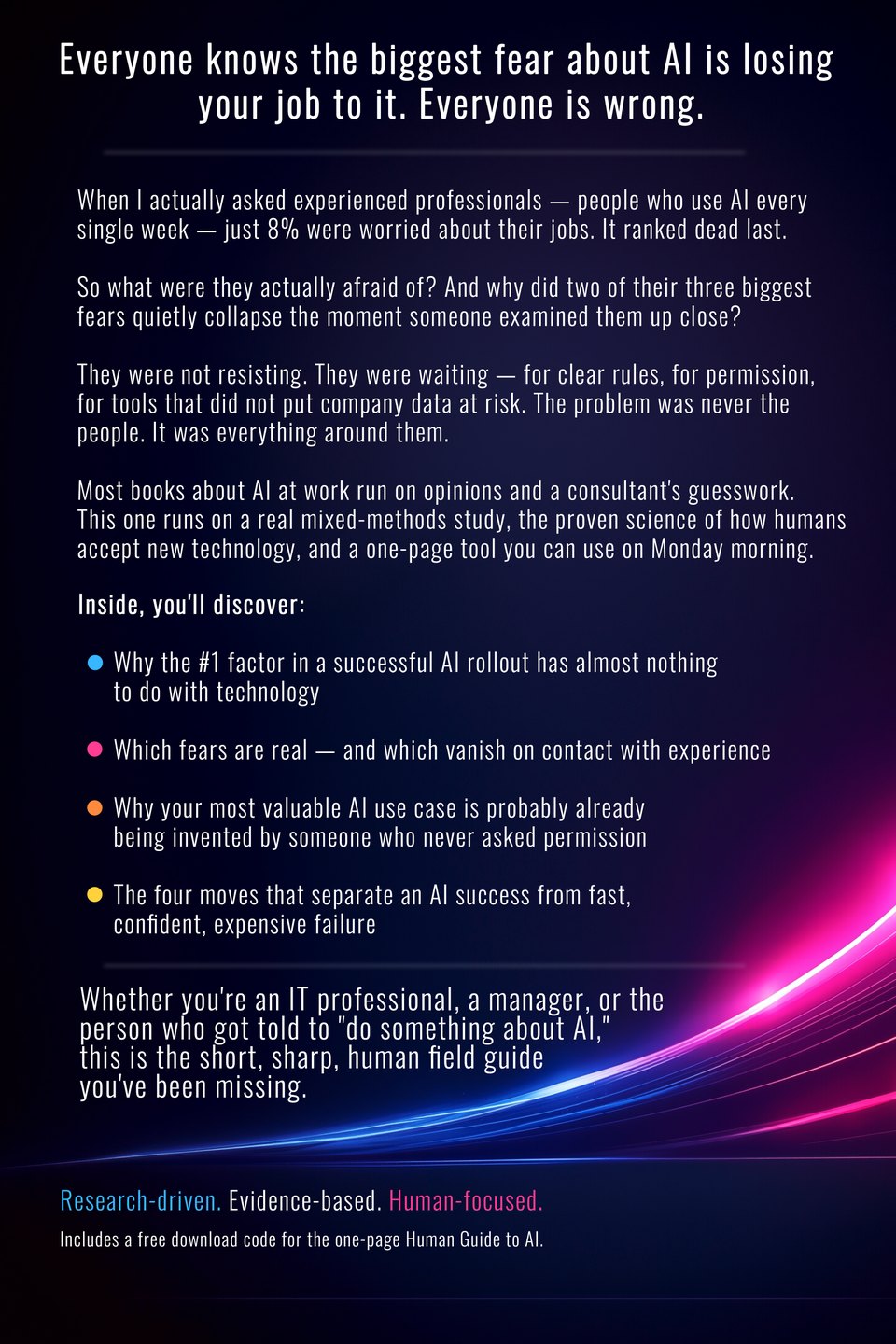
When experienced professionals were asked, just 8% worried about their jobs — this specific fear ranked dead last. The real blockers of generative AI at work were rules, permission and trust. A Human Guide to AI shows you how to fix them.
What the study found
Experienced knowledge workers, asked properly — and the answers turn the usual AI change-management playbook upside down.
97%
Before any rollout. Private use outweighed work-only use five to one — your people are teaching themselves.
59.5%
Not paranoia, professionalism. You answer it with architecture — safe tools and clear rules — not persuasion.
8.1%
It came dead last. Most rollouts are designed around a fear almost nobody holds.
4.01 / 7
People were willing. The visible signal from leadership that AI is expected never came.
The science behind it
In 2003 a team led by Viswanath Venkatesh fused eight acceptance theories into one model — UTAUT, the Unified Theory of Acceptance and Use of Technology. Picture a mixing desk: push the sliders up in the right combination and people use the thing. Leave one down and you get quiet sabotage.
In the study, the two lowest dials were exactly the two the organization controls: endorsement and support.
Free tools
The AI readiness assessment and the full adoption survey from the book. Anonymous, no cookies, no login.
AI Readiness Check
The 15-question self-assessment from Chapter 9 of the book. Score your organization on the five dials of technology acceptance and see them next to the study’s figures — plus the one thing to fix first.
Anonymous · no cookies · no login
Team mode · for organizers
Your colleagues answer anonymously through a shared link. You watch the results on your own dashboard — no account, no login. Results unlock at 5 responses so nobody can be singled out.
Team mode · lost links
Enter the email address you used when you created the team survey. If it is still active, we send the team link and your dashboard link to that address.
Your result
Study benchmark
Fix this first
Keep your result
Get it by email — as a PDF, plus the one-page Human Guide to AI and the moves that fix your lowest dial.
Double opt-in: you confirm your address first. Used only to send what you asked for · Privacy policy
Check your inbox
Thank you — your anonymous answers were added to your team’s results.
AI Adoption Survey
The complete questionnaire from the study behind the book — grounded in scientific research on AI and work. It covers experience with generative AI tools such as ChatGPT, Microsoft Copilot, DALL·E and Midjourney, hopes and concerns, the five acceptance drivers and your general outlook. Whether you already use AI or not, every viewpoint matters. All responses are completely anonymous.
Anonymous · no cookies · no login
Team mode · for organizers
Your colleagues answer anonymously through a shared link. You watch the results on your own dashboard — no account, no login. Results unlock at 5 responses so nobody can be singled out.
Team mode · lost links
Enter the email address you used when you created the team survey. If it is still active, we send the team link and your dashboard link to that address.
Your result
Study benchmark
Fix this first
Keep your result
Get it by email — as a PDF, plus the one-page Human Guide to AI and the moves that fix your lowest dial.
Double opt-in: you confirm your address first. Used only to send what you asked for · Privacy policy
Check your inbox
Thank you — your anonymous answers were added to your team’s results.
Free download


The whole playbook on one sheet — the acceptance & trust model, five guiding principles and the seven-step rollout on the front, all thirteen recommendations on the back. Print it, pin it, hand it to your team.
Also included


All PDFs are also available in German.
The book
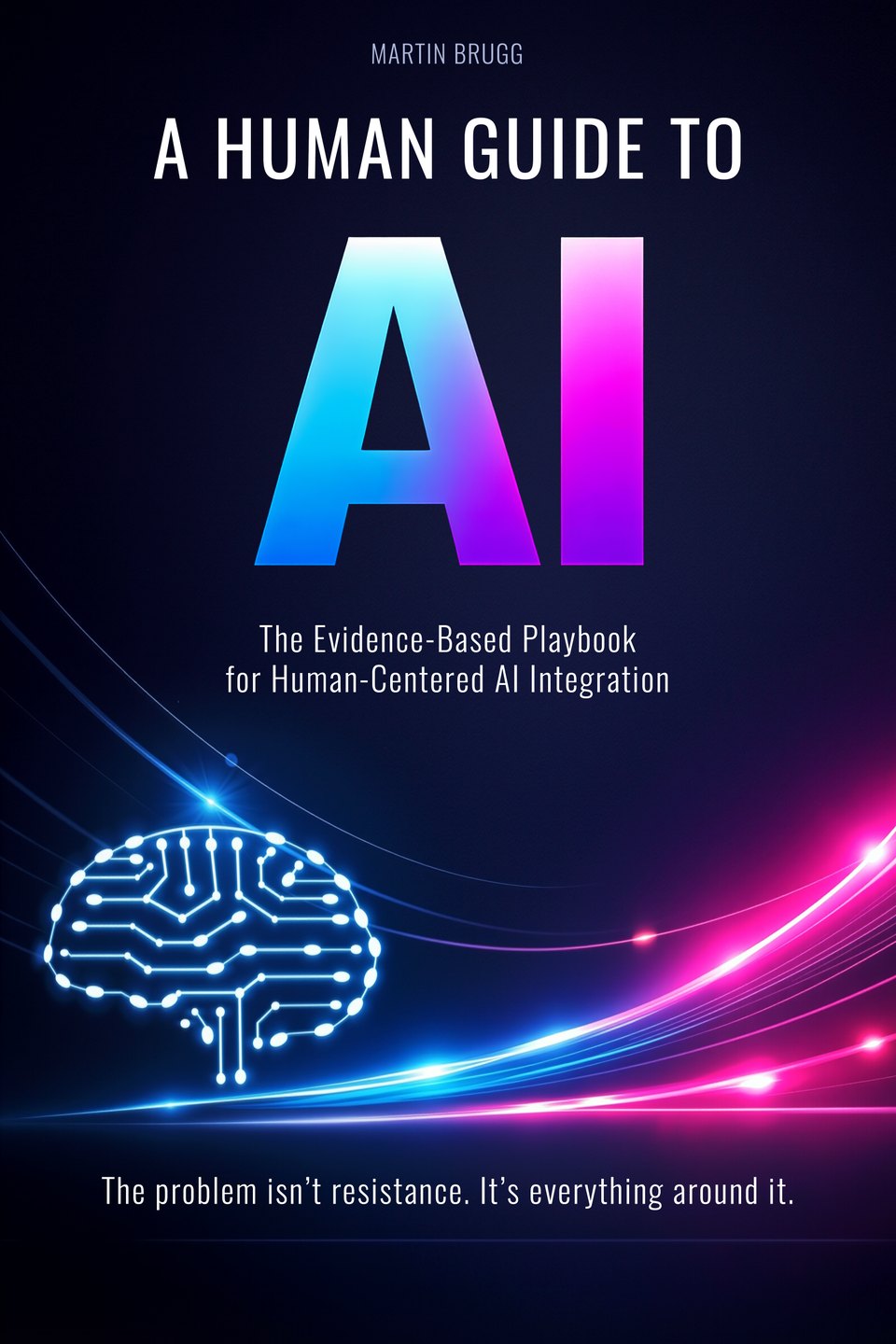
A mixed-methods study of the people actually using generative AI at work, the forty-year-old science of technology acceptance, and the one-page Human Guide to AI you can use on Monday morning. Short, sharp, human.
Free · the one-page Human Guide to AI
The Human Guide to AI distills the study into a single page you can pin above your desk: how acceptance and trust grow, five guiding principles and a seven-step rollout on the front — every recommendation, O1–O7 and P1–P6, on the back.
The playbook
Thirteen moves — seven for the organization, six for its people — and a ninety-day plan to put them to work.
Seven moves that build the stage
Establish genuine, visible leadership commitment before any technology arrives: leaders using the tools themselves, talking about them, and putting real weight behind the initiative — not delegating it to IT with a blessing.
Clear data-protection rules and secure tool choices, including protected solutions for sensitive work. This answers the number-one fear in the study — data privacy, named by nearly 60 percent. You cannot talk people out of it; you build past it.
Usage rules that apply to everyone — explicitly including leadership. Rules with exceptions for the powerful corrode trust; uniform rules make the whole initiative feel legitimate.
An AI coordinator or small steering group that owns the rollout, keeps the rules current and is the obvious place to bring questions. It doesn’t need to be big. It needs to exist and be known.
Start where the value is highest, run a pilot, gather feedback, then widen. Recruit champions in each area. A wave-based rollout lets you get it right the third time, quietly, before most people are even affected.
Actively communicate benefits and safeguards with concrete examples people recognize from their own work. Silence lets the scary version win by default.
License by role, define pilot metrics in advance and evaluate return step by step. Defining success in numbers turns an act of faith into a manageable investment.
Six moves that build capability and confidence
Role-specific training and on-demand explainers; deliberately develop willing people into confident power users. Generic “here’s ChatGPT” training helps no one.
Teach people to spot hallucinations, check sources, treat AI output as a draft rather than a verdict, and keep final decisions in human hands. The AI drafts and suggests; the human checks, questions and decides.
Make use voluntary at first and celebrate what people build for themselves. The best use cases in your organization will be invented by your own people if you let them.
Approachable key users who are everyday points of contact. Every team needs someone who can be asked the “dumb” question without judgment.
A recurring show-and-tell, a channel for swapping prompts and wins. Structured sharing turns AI from an isolating screen habit into a shared adventure.
AI is not magic and not a replacement for people — say so out loud. Name the top fears openly; take privacy and overtrust seriously and gently retire the fears the evidence deflated.
Get the leadership team together and do not leave without three things. If you cannot get them, stop here — stopping in week one is cheap; stopping in month nine is not.
Run the readiness check across leadership and a sample of staff, and compare the two. The gap tells you which moves to start with.
Draft governance on one page (plus annexes for a large organization). Nobody reads twenty pages.
Appoint the coordinator or steering group and make them findable. Announce what is coming, why — and that it is not a headcount exercise.
Pick one or two areas with obvious, visible value — not the department that shouted loudest.
In the very first session, before anyone falls in love with the machine’s fluency, teach the habit that matters most: check the output, check the source, own the decision.
Your champions emerge this week — and so does your first frustrated non-adopter. Talk to them; the skeptic tells you what will break at scale.
Measure against your metrics and gather the grassroots stories — find the person who built something for themselves.
Rewrite unworkable policy, change boring training, drop the tool nobody used. A rollout that visibly listens earns more trust than one that arrives perfect.
Share the numbers, the grassroots story and at least one thing that went wrong. Your credibility for the next ninety days is set here.
Extend to the next two or three areas, carrying your champions with you, and stand up the community of practice.
Compare metrics with license and time costs. Decide where to expand and where to stop.
Nothing is saved — this checklist lives only in your browser tab. The printable version is in the book’s appendix.

About the author
Martin Brugg has worked in information technology for over twenty-five years — through the arrival of the internet, the smartphone, the cloud, and now generative AI. He has spent that time where technology meets the people who actually have to use it: rollouts, migrations, support desks, and the quiet conversations afterward about what went wrong. He started as an apprentice IT technician, went on to earn a bachelor’s degree in business informatics, and later completed an executive master’s degree. This book grew out of his graduate research into how people adopt generative AI at work — a mixed-methods study combining a survey of experienced professionals with in-depth expert interviews.
FAQ
Leaders, managers, IT and project owners, HR — anyone who has to make AI work with real people, not just switch it on. It is short, practical and built on evidence rather than hype.
Yes. No names, no email addresses, no IP addresses and no cookies are stored with your answers. In team mode, results only appear once at least five people have answered, so nobody can be singled out.
Yes. Create a team link, share it with your colleagues and follow the anonymous results on your own private dashboard. No account and no login needed.
There is none. The tools are free because the idea behind them matters more to me than revenue. The debate about AI is mostly about models, licenses and productivity — and far too little about the people who are supposed to work with it. The study showed that adoption fails on rules, permission and trust, not on technology. The more organizations measure exactly that and talk about it openly, the better AI at work becomes — for everyone. Not everything has to be turned into money. No ads, no tracking, no selling of data, and what is free today is meant to stay free. If the tools help you, the book goes deeper — and a short review on Amazon helps others find it.
It is only used after you confirm it (double opt-in), to send you the downloads and occasional notes on AI adoption. It stays on this website — not with a newsletter provider — and every email lets you unsubscribe and delete your data with one click.
Printed on the “About the Author” page at the end of the book. Enter it in the download section and everything unlocks instantly, without an email address.
No. The book and the tools are general professional guidance. Always adapt any recommendation to your own organization’s rules and the laws that apply to you.
A Human Guide to AI
The research, the playbook and the one-page Human Guide to AI — in a book you can finish on a flight and use the next morning.
Questions, a workshop, or feedback on a tool? Contact me →
Contact
Questions about the book, an AI rollout in your organization, or feedback on one of the tools? Send me a message — I read every one personally.
I will get back to you personally, usually within a few days.