97%
had already used generative AI
Before any rollout. Private use outweighed work-only use five to one — your people are teaching themselves.
Evidence-based AI adoption
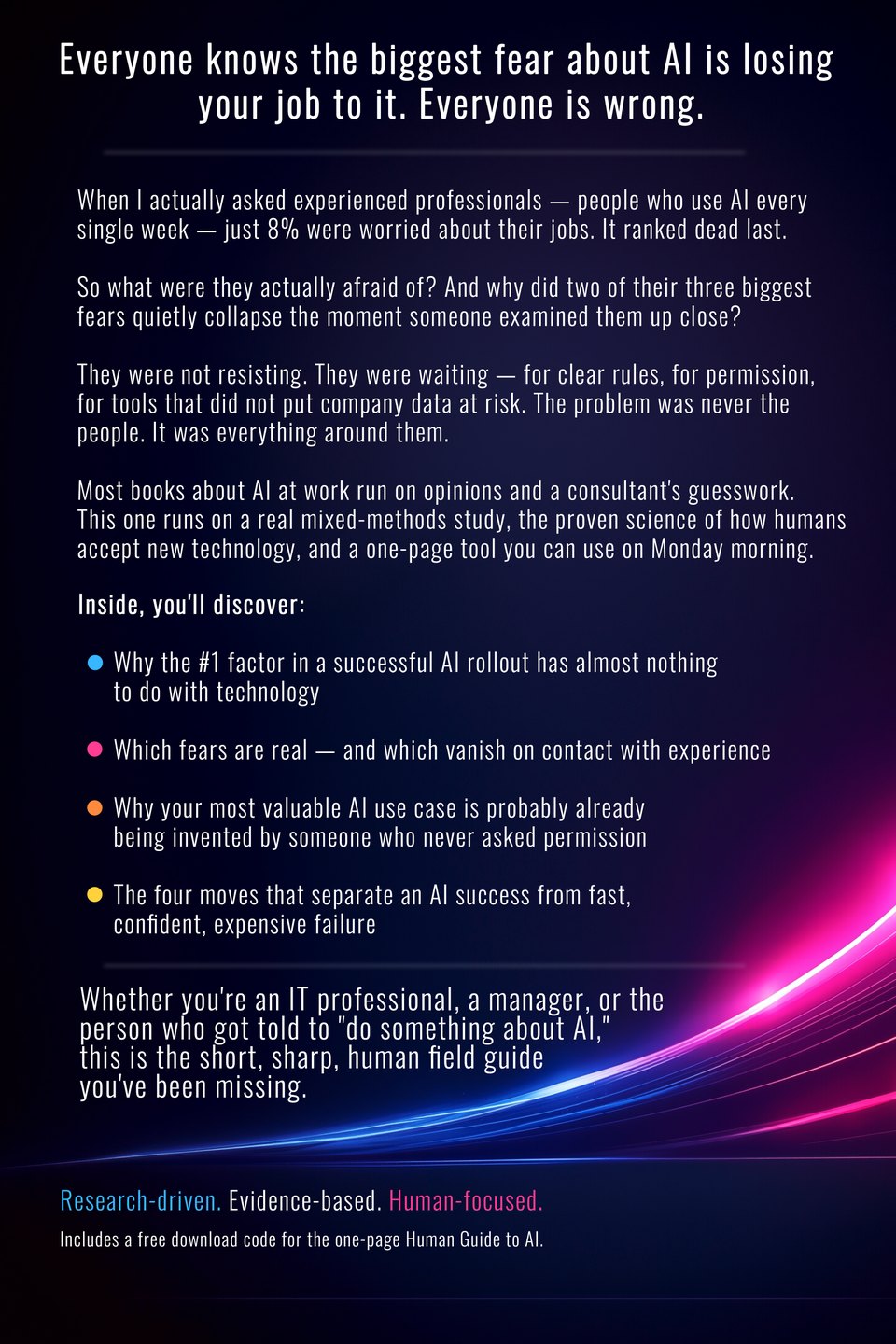
When experienced professionals were asked, just 8% worried about their jobs — this specific fear ranked dead last. The real blockers of generative AI at work were rules, permission and trust. A Human Guide to AI shows you how to fix them.
What the study found
Experienced knowledge workers, asked properly — and the answers turn the usual AI change-management playbook upside down.
97%
Before any rollout. Private use outweighed work-only use five to one — your people are teaching themselves.
59.5%
Not paranoia, professionalism. You answer it with architecture — safe tools and clear rules — not persuasion.
8.1%
It came dead last. Most rollouts are designed around a fear almost nobody holds.
4.01 / 7
People were willing. The visible signal from leadership that AI is expected never came.
The science behind it
In 2003 a team led by Viswanath Venkatesh fused eight acceptance theories into one model — UTAUT, the Unified Theory of Acceptance and Use of Technology. Picture a mixing desk: push the sliders up in the right combination and people use the thing. Leave one down and you get quiet sabotage.
In the study, the two lowest dials were exactly the two the organization controls: endorsement and support.
Free tools
The AI readiness check from the book and the one-page Human Guide to AI. Anonymous, no cookies, no login — more tools for teams are coming soon.
AI Readiness Check
The 15-question self-assessment from Chapter 9 of the book. Score your organization on the five dials of technology acceptance and see them next to the study’s figures — plus the one thing to fix first.
Anonymous · no cookies · no login
Your result
Study benchmark
Fix this first
Keep your result
Get it by email — as a PDF, plus the one-page Human Guide to AI and the moves that fix your lowest dial.
Double opt-in: you confirm your address first. Used only to send what you asked for · Privacy policy
Check your inbox
Thank you — your anonymous answers were added to your team’s results.
Coming soon
I am putting the finishing touches on further tools that take the approach of the book from one person to whole teams and organizations — free, anonymous and without cookies, like everything on this site.
Just this one email, no newsletter. You confirm your address first. Privacy policy
In the meantime: take the 3-minute readiness check · get the one-page Human Guide to AI
Free download


The whole playbook on one sheet — the acceptance & trust model, five guiding principles and the seven-step rollout on the front, all thirteen recommendations on the back. Print it, pin it, hand it to your team.
The guide is also available in German.
The book
A mixed-methods study of the people actually using generative AI at work, the forty-year-old science of technology acceptance, and the one-page Human Guide to AI you can use on Monday morning. Short, sharp, human.
Free · the one-page Human Guide to AI
The Human Guide to AI distills the study into a single page you can pin above your desk: how acceptance and trust grow, five guiding principles and a seven-step rollout on the front — every recommendation, O1–O7 and P1–P6, on the back.
The playbook
Thirteen moves — seven for the organization, six for its people — and a ninety-day plan to put them to work.
Coming soon
Thirteen concrete moves and a ninety-day plan — step by step, right here on the website. Until then, you will find the whole playbook in the book.
Just this one email, no newsletter. You confirm your address first. Privacy policy
In the meantime: get the book · get the one-page Human Guide to AI

About the author
Martin Brugg has worked in information technology for over twenty-five years — through the arrival of the internet, the smartphone, the cloud, and now generative AI. He has spent that time where technology meets the people who actually have to use it: rollouts, migrations, support desks, and the quiet conversations afterward about what went wrong. He started as an apprentice IT technician, went on to earn a bachelor’s degree in business informatics, and later completed an executive master’s degree. This book grew out of his graduate research into how people adopt generative AI at work — a mixed-methods study combining a survey of experienced professionals with in-depth expert interviews.
FAQ
Leaders, managers, IT and project owners, HR — anyone who has to make AI work with real people, not just switch it on. It is short, practical and built on evidence rather than hype.
Yes. No names, no email addresses, no IP addresses and no cookies are stored with your answers.
Yes. Further tools for teams and organizations and the playbook with its thirteen moves are in their final checks. Leave your email address in the tools section and you get exactly one email when they are live.
There is none. The readiness check and the one-page Human Guide to AI are free — for you and your team. The guide is protected by copyright, though: please do not sell it, change it or publish it as your own. More free tools will follow soon. No ads, no tracking, no selling of data. If the guide helps you, the book goes deeper — and a short review on Amazon helps others find it.
It is only used after you confirm it (double opt-in), to send you the downloads and occasional notes on AI adoption. It stays on this website — not with a newsletter provider — and every email lets you unsubscribe and delete your data with one click.
Printed on the “About the Author” page at the end of the book. Enter it in the download section and everything unlocks instantly, without an email address.
No. The book and the tools are general professional guidance. Always adapt any recommendation to your own organization’s rules and the laws that apply to you.
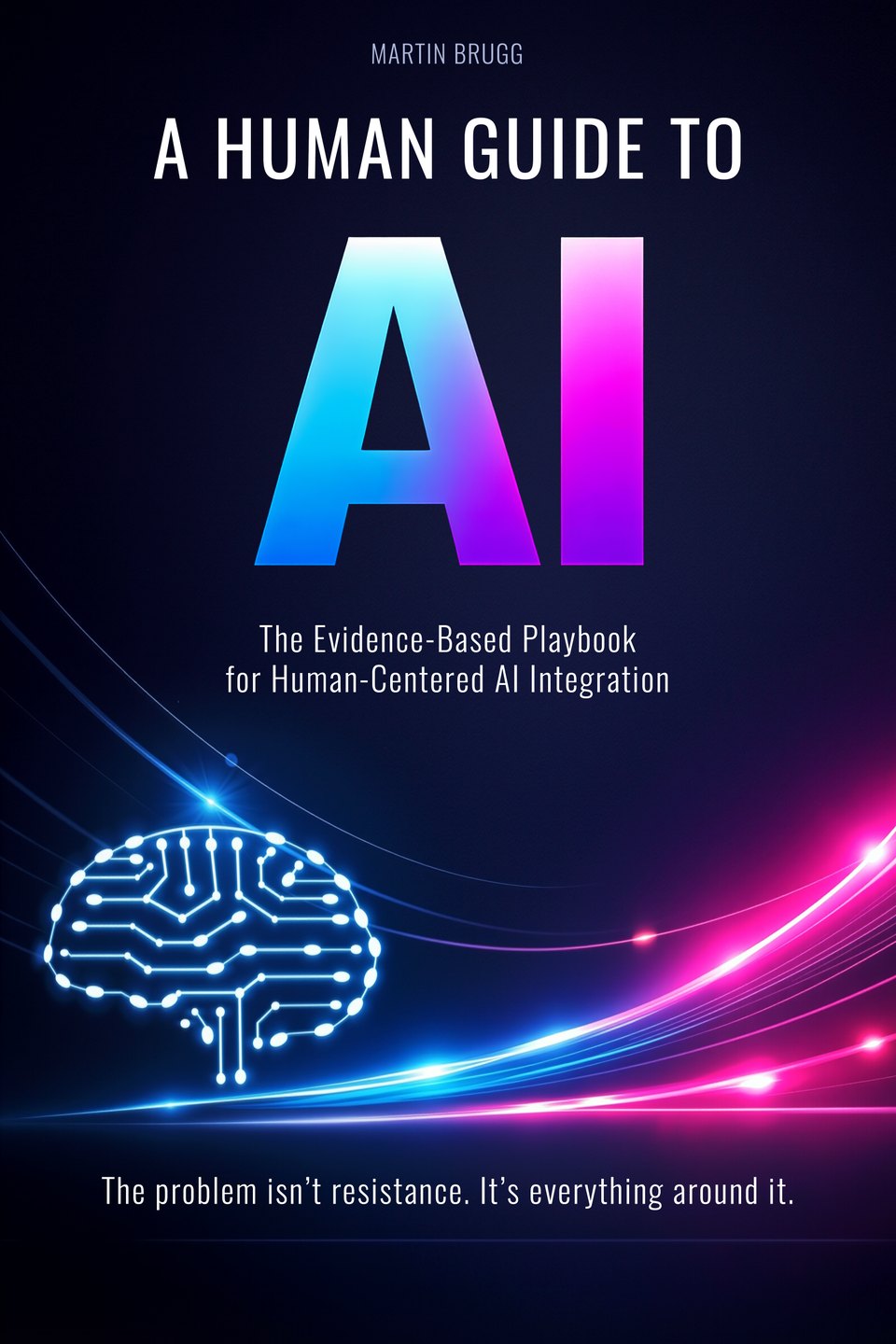
A Human Guide to AI
The research, the playbook and the one-page Human Guide to AI — in a book you can finish on a flight and use the next morning.
Questions, a workshop, or feedback on a tool? Contact me →
Contact
Questions about the book, an AI rollout in your organization, or feedback on one of the tools? Send me a message — I read every one personally.
I will get back to you personally, usually within a few days.